Tell us about the job
Takes about a minute. No obligation.
Gas venting, combustion air, and line sizing are the first things a contractor establishes before quoting a water heater replacement here. Utility gas heats more occupied homes in Sweet Grass County, Montana than any other fuel, at 46.6% (2020-2024 ACS 5-year). That majority shapes what a replacement is allowed to be: a straight switch to another fuel source requires different venting, a different permit path, and often changes to the gas supply line itself. Contractors who work this area price the full installation around those requirements, not around the unit alone.
Ductwork sized and routed for equipment that has since been replaced at least once sets the terms for what a new water heater installation actually involves. Half the homes in Sweet Grass County, Montana were built in 1979 or earlier (2020-2024 ACS 5-year). A contractor working through stock like this checks whether the existing runs, venting paths, and electrical service are compatible with what the homeowner is putting in, and those checks produce real answers: a flue that needs relining, a panel circuit that will not carry the load, a run that was never meant to serve the location the new unit has to go. The equipment choice is straightforward by comparison.
What a Water Heater Installation Puts in Your Home
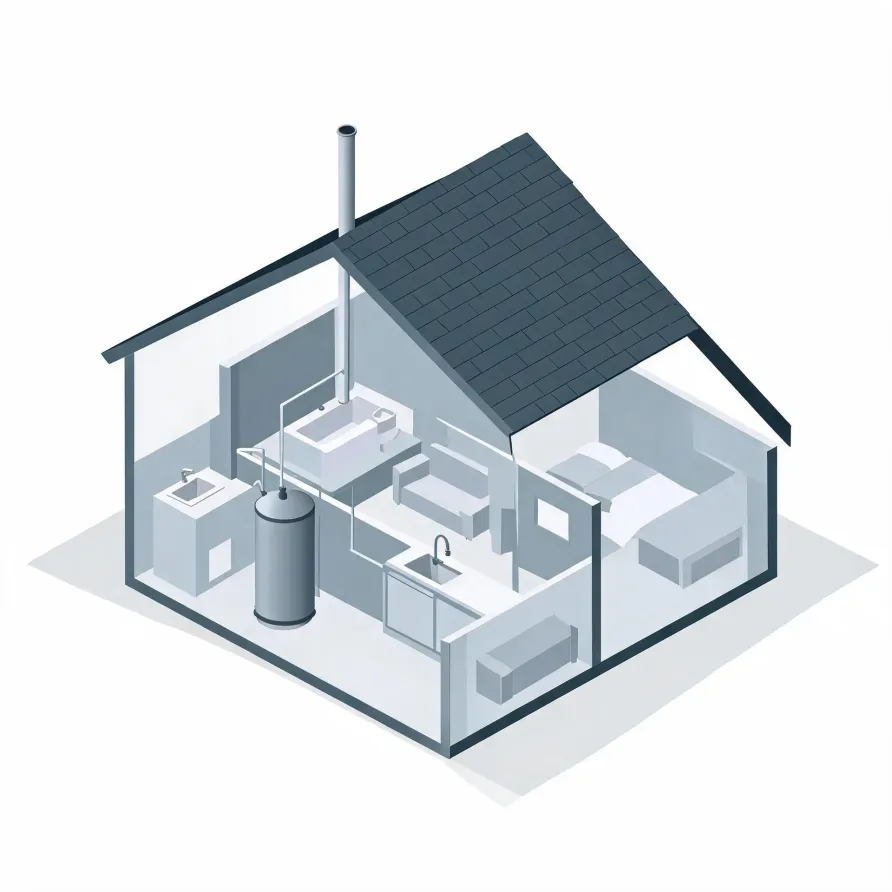
The tank is the piece most homeowners recognize: a tall cylinder that sits in a utility room, basement, or garage and holds a ready supply of hot water. Bolted to its top are the inlet and outlet connections, which bring cold water in and send hot water out to every fixture in the house.
The pressure relief valve mounts on the side of the tank and opens automatically if pressure inside climbs too high. Near the base, the drain valve allows a contractor to flush the tank during the install. The anode rod hangs inside the tank unseen, slowing corrosion of the steel shell.
The drawing shows a typical layout, and a licensed contractor determines exactly what the installation involves for your specific home.
Find a contractor in Sweet Grass CountySweet Grass County, by the numbers
398 severe weather events were recorded in Sweet Grass County, Montana between 2015 and 2024.
NOAA National Centers for Environmental Information, Storm Events Database, bulk CSV export, events 2015-01-01 through 2024-12-31.Half the homes in Sweet Grass County, Montana were built in 1979 or earlier (2020-2024 ACS 5-year).
U.S. Census Bureau, 2020-2024 American Community Survey 5-Year EstimatesSweet Grass County, Montana holds 1,900 housing units (2020-2024 ACS 5-year).
U.S. Census Bureau, 2020-2024 American Community Survey 5-Year EstimatesOwners occupy 79.7% of the occupied homes in Sweet Grass County, Montana (2020-2024 ACS 5-year).
U.S. Census Bureau, 2020-2024 American Community Survey 5-Year EstimatesSevere Weather Events in Sweet Grass County
Extreme weather puts a hard load on water heating equipment, shortening service life and pushing systems past their design limits. How often that pressure arrives in Sweet Grass County shapes what a water heater here needs to handle.
398 severe weather events, 2015–2024. Source: NOAA National Centers for Environmental Information, Storm Events Database.