Tell us about the job
Takes about a minute. No obligation.
Gas-fired water heaters carry a specific set of wear points: the burner orifice, the thermocouple, and the flue connection. Utility gas heats more occupied homes in Richland County, Montana than any other fuel, at 54.5% (2020-2024 ACS 5-year). A contractor diagnosing a repair in this county starts at the combustion side, not the tank itself, because gas appliances fail there first. Sediment and anode wear matter too, but a burner that fires poorly or a thermocouple that reads cold explains most of the repair calls a technician sees here.
Half the homes in Richland County, Montana were built in 1980 or earlier (2020-2024 ACS 5-year). A house that old has put its water heater through a long run of freeze-thaw cycles, high sediment loads, and the kind of mineral buildup that quietly shortens anode rod life and clogs drain valves. When a contractor opens the unit, those conditions show up as real findings: corroded connections, a spent anode, sediment layering the tank floor. Parts for systems installed in stock this vintage are not always still in production, so what the opened unit actually contains sets the repair scope, and sometimes the decision between a repair and a replacement.
The Parts of a Water Heater a Contractor Checks First
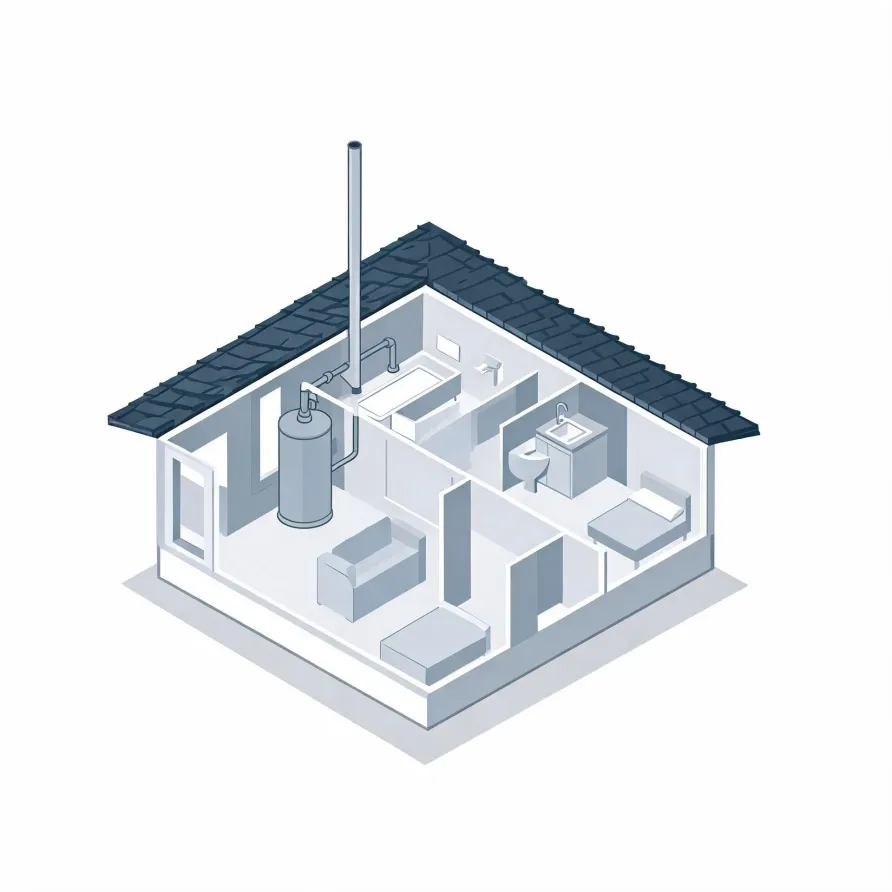
The tank is what most homeowners picture: a large insulated cylinder that sits in a utility room, basement, or garage and holds a supply of heated water. Inside it, a burner or heating element does the actual heating. When the water runs cold or the supply is inconsistent, the burner, the element, or the thermostat controlling either one is where a contractor looks first.
The pressure relief valve mounts on the side of the tank and opens automatically if pressure builds past a safe point. The anode rod hangs inside the tank and slows corrosion of the tank walls. The dip tube carries cold incoming water to the bottom of the tank, and the flue or exhaust vent runs upward from a gas unit to move combustion gases out of the house.
The drawing shows the general layout of a water heater system, and a licensed contractor determines which parts apply to the specific unit and installation in your home.
Find a contractor in Richland CountyRichland County, by the record
163 severe weather events were recorded in Richland County, Montana between 2015 and 2024.
NOAA National Centers for Environmental Information, Storm Events Database, bulk CSV export, events 2015-01-01 through 2024-12-31.Half the homes in Richland County, Montana were built in 1980 or earlier (2020-2024 ACS 5-year).
U.S. Census Bureau, 2020-2024 American Community Survey 5-Year EstimatesRichland County, Montana holds 5,610 housing units (2020-2024 ACS 5-year).
U.S. Census Bureau, 2020-2024 American Community Survey 5-Year EstimatesOwners occupy 67.1% of the occupied homes in Richland County, Montana (2020-2024 ACS 5-year).
U.S. Census Bureau, 2020-2024 American Community Survey 5-Year EstimatesSevere Weather Events in Richland County
Extreme weather puts real stress on water heaters, forcing them to work harder and wear faster. How much strain a unit takes over its life depends heavily on local conditions, which is why weather history in Richland County matters when thinking about repair needs.
163 severe weather events, 2015–2024. Source: NOAA National Centers for Environmental Information, Storm Events Database.