Tell us about the job
Takes about a minute. No obligation.
Gas water heater installation in Lewis and Clark County starts with questions the unit price does not answer. Utility gas heats more occupied homes in Lewis and Clark County, Montana than any other fuel, at 56.6% (2020-2024 ACS 5-year). A contractor sizing a replacement has to account for venting configuration, combustion air supply, and whether the existing flue can carry the new appliance's exhaust load. Those are conditions set by the fuel the home burns, and a water heater that is piped or vented wrong will underperform or fail well before its time. Getting those details right at installation is what separates a unit that holds up from one that does not.
The electrical panel in a Lewis and Clark County house carries a history. Half the homes in Lewis and Clark County, Montana were built in 1982 or earlier (2020-2024 ACS 5-year). Service panels in houses of that vintage were sized for loads that looked nothing like a modern water heater's draw, and what a contractor finds at the panel decides whether the installation is straightforward or whether it requires an electrician before anything else moves forward. The unit itself is often the smaller part of the job.
What Gets Installed With a New Water Heater
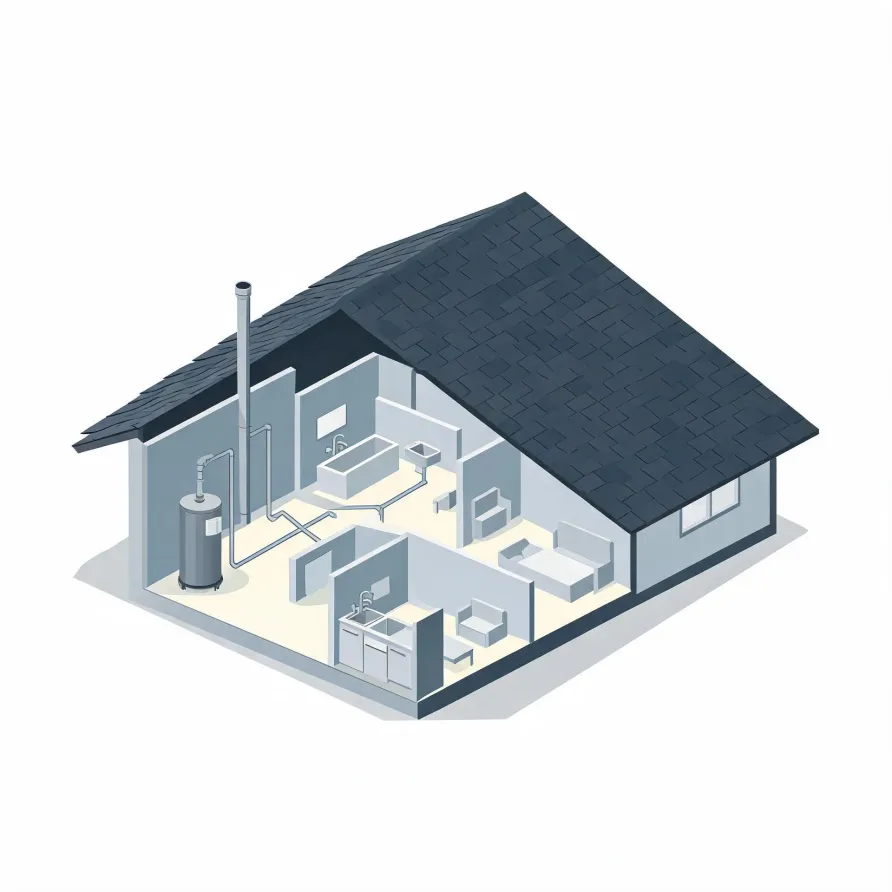
The tank is the centerpiece of the system. It sits in a utility room, basement, or garage and holds a supply of water that a burner or heating element keeps at a set temperature. Cold water enters at the bottom through a dip tube, and hot water exits from the top through the hot outlet.
A pressure relief valve mounts on the side of the tank and releases if pressure inside climbs too high. The anode rod hangs inside the tank and slows corrosion of the tank walls. A drain valve at the base allows a contractor to flush sediment from the tank floor.
The drawing shows a general layout of these components, and a licensed contractor determines exactly how they apply to your home's setup.
Find a contractor in Lewis and Clark CountyLewis and Clark County, by the numbers
245 severe weather events were recorded in Lewis and Clark County, Montana between 2015 and 2024.
NOAA National Centers for Environmental Information, Storm Events Database, bulk CSV export, events 2015-01-01 through 2024-12-31.Half the homes in Lewis and Clark County, Montana were built in 1982 or earlier (2020-2024 ACS 5-year).
U.S. Census Bureau, 2020-2024 American Community Survey 5-Year EstimatesLewis and Clark County, Montana holds 34,082 housing units (2020-2024 ACS 5-year).
U.S. Census Bureau, 2020-2024 American Community Survey 5-Year EstimatesOwners occupy 70.1% of the occupied homes in Lewis and Clark County, Montana (2020-2024 ACS 5-year).
U.S. Census Bureau, 2020-2024 American Community Survey 5-Year EstimatesSevere Weather Events in Lewis and Clark County
Water heaters work harder when outdoor conditions swing hard, and Montana's climate puts real stress on equipment over time. How much stress depends on where you are, which makes local weather history a practical part of sizing and installing a water heater in Lewis and Clark County.
245 severe weather events, 2016–2024. Source: NOAA National Centers for Environmental Information, Storm Events Database.